

Your Gateway to Ngorongoro: What Every Traveler Should Know First

The journey from Kilimanjaro Airport to Ngorongoro Crater is one of the most iconic road trips in East Africa — but it helps to know what you’re getting into before you land.
Book Your Transfer
Fill in your details and we'll confirm your booking on WhatsApp.
Quick answer for travelers:
| Detail | Info |
|---|---|
| Distance | ~250 km (155 miles) |
| Typical drive time | ~4 hours 50 minutes |
| Main route | JRO → Arusha → Karatu → Ngorongoro |
| Transfer options | Private taxi, VIP transfer, shared shuttle, group bus |
| Starting price | From $50 (private taxi, one-way) |
| Best time to travel | Morning departure, June–September (dry season) |
Kilimanjaro International Airport (IATA: JRO) is the main entry point for safari travelers heading to northern Tanzania. It sits about 46 km from Arusha — the region’s safari hub — and from there, the road continues west through highlands and Maasai villages all the way to the crater rim.
This route is beautiful, but it comes with real decisions to make: Which transfer type fits your budget? When should you leave? What permits do you need at the gate?
This guide breaks it all down clearly, so you can travel with confidence and avoid the common pitfalls — overcharging, delays, and arriving unprepared.
Distance and Travel Time: Kilimanjaro Airport to Ngorongoro

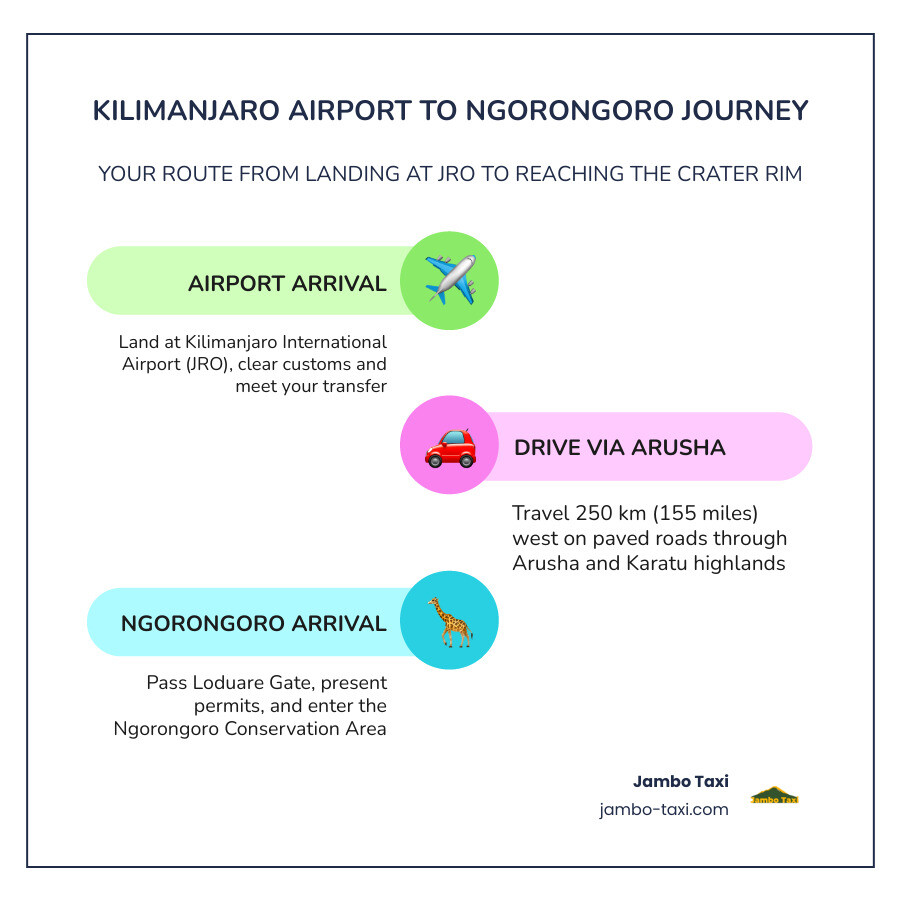
When planning your Tanzanian adventure, mapping out your travel times is crucial to avoid spending your entire first day rushed or stressed. The journey from Kilimanjaro Airport to Ngorongoro covers approximately 250 kilometers (155 miles) of incredibly diverse terrain.
If you are driving directly from the airport terminal to the conservation entry gate, you should expect a typical driving time of around 4 hours and 50 minutes. However, this is highly dependent on traffic flow through Arusha, weather conditions, and the type of vehicle you choose.
The route begins on the well-paved A104 highway, heading west past Mount Meru. For a detailed breakdown of the entry point where you will land, you can consult this helpful Kilimanjaro International Airport (JRO) | Tanzania Gateway resource. As you pass through Arusha, the road transitions to the B144 highway, which guides you through the agricultural towns of Monduli and Karatu before climbing up the spectacular Great Rift Valley escarpment.
To help you visualize how this route fits into the broader Northern Safari Circuit, we have compiled a comparison table of distances and driving times:
Travel Distance & Time Comparison Table
| Route | Distance (km) | Distance (miles) | Approximate Driving Time | Road Type / Condition |
|---|---|---|---|---|
| Kilimanjaro Airport (JRO) to Ngorongoro | 250 km | 155 mi | 4 hours 50 mins | Fully paved highways (A104 & B144) |
| Arusha Town to Ngorongoro Crater | 180 km | 112 mi | 3 hours | Paved highway, moderate traffic |
| Kilimanjaro Airport to Arusha | 46 km | 29 mi | 1 hour | Paved highway, commuter traffic |
| Serengeti (Seronera) to Ngorongoro | 140 km | 90 mi | 3 hours | Gravel, corrugations, wildlife delays |
| Lake Manyara to Ngorongoro Crater | 80 km | 50 mi | 2 hours | Paved to steep gravel climb |
| Tarangire National Park to Ngorongoro | 180 km | 110 mi | 4 hours | Paved with dirt transition roads |
That while the highway is fully tarred all the way to the Loduare Gate (the main entrance to the Ngorongoro Conservation Area), the road conditions inside the conservation area change dramatically. Once you cross the gate, you will be driving on unpaved, gravel, and volcanic soil tracks that can become slippery during the rainy seasons. For more details on what to expect at the airport terminal itself, check out this comprehensive Kilimanjaro Airport Guide – JRO Travel Info – African Scenic Safaris .
Transport Options for Your Transfer
Getting from the baggage claim at JRO to the majestic crater rim doesn’t have a “one-size-fits-all” solution. Depending on your group size, budget, and appetite for adventure, there are several distinct transport options available.
Selecting the right ride is the difference between starting your vacation relaxed and spotting wildlife, or starting it with a sore back and a headache. At Jambo Taxi, we specialize in making this transition seamless with our professional Airport to Hotel Transfers and long-distance safari connections.
Private Taxi from Kilimanjaro Airport to Ngorongoro
For the majority of travelers, a private taxi transfer is the gold standard of convenience. From the moment you clear customs, your dedicated driver is waiting for you in the arrivals hall with a placard bearing your name.
- Comfort & Privacy: You don’t have to share your space with strangers, meaning you can stretch out, play your own music, or take a nap after a long international flight.
- Flexibility: Want to stop for a cold local drink, take a photo of Mount Meru, or use the restroom? A private taxi allows you to set the schedule.
- Direct Route: There are no detours to drop off other passengers at different hotels. It is a straight, efficient run from JRO to your lodge.
If your travel itinerary requires you to stop or stay overnight in Arusha first to break up the journey, you can easily book a reliable Kilimanjaro Airport to Arusha transfer with us before continuing onward.
VIP and Luxury Transfers
If you want to elevate your Tanzanian journey into an elite experience, VIP transfers are the way to go. This service typically utilizes high-end, air-conditioned 4×4 luxury SUVs (such as Toyota Land Cruisers) or premium executive vans.
With a professional, English-speaking driver at the wheel, you will enjoy complimentary bottled water, onboard Wi-Fi (where network coverage allows), charging ports for your devices, and superior suspension to absorb any bumps along the road. It is the perfect option for honeymooners, corporate travelers, or anyone who values maximum comfort on longer road trips.
Shared Shuttle and Group Bus Options
For solo travelers, backpackers, or those looking to keep costs to an absolute minimum, shared transfers offer an alternative.
- Shared Shuttles: These run on semi-regular schedules, usually departing from Arusha or JRO. While highly budget-friendly, they require flexibility as you may have to wait for other passengers to arrive, and drop-offs are made at multiple locations.
- Group Minibuses & Coaches: For large organized groups, family reunions, or school trips, chartering a 20-seater group shuttle or a massive 40-seater coach is highly cost-effective. These must be booked well in advance to ensure availability.
For comprehensive regional options, travelers can also research kilimanjaro airport transfers – Mj Safaris to compare private and group-focused itineraries on the northern circuit.
Planning Your Journey: Weather, Road Conditions, and Best Times to Travel
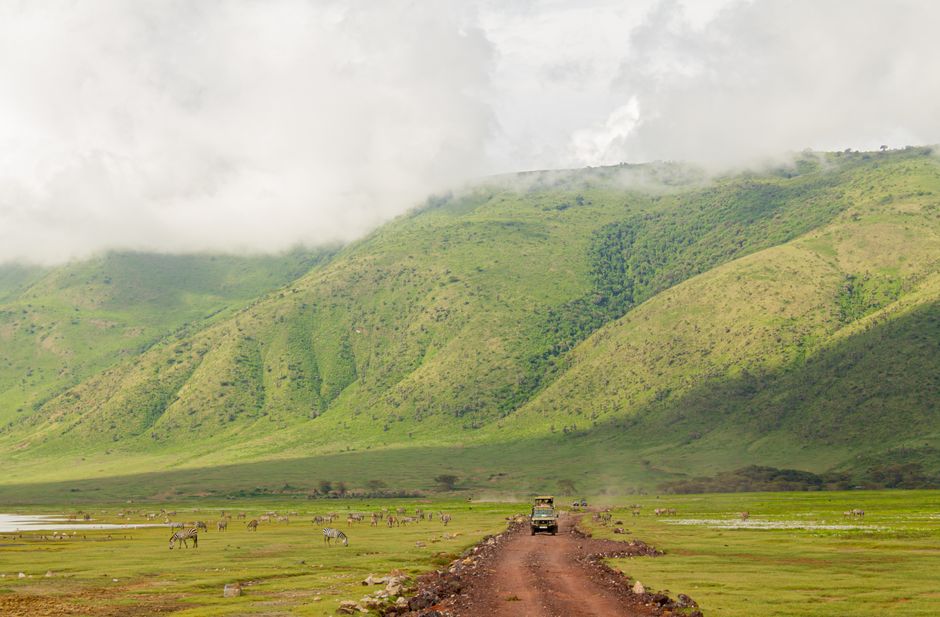
A successful trip along the kilimanjaro airport to ngorongoro route requires a bit of strategic planning. Tanzania’s weather and traffic patterns can quickly turn a 5-hour drive into an 8-hour marathon if you don’t time things correctly. To ensure you have the best experience possible, we highly recommend reading through the Ngorongoro Crater Travel Advice (Easy Big 5 Viewing) – Go2Africa for expert tips on seasonal packing and wildlife habits.
Best Time of Day for a Kilimanjaro Airport to Ngorongoro Transfer
We always advise our guests to plan for a morning departure whenever possible. Leaving early in the day (between 6:00 AM and 8:00 AM) offers several massive advantages:
- Beating the Arusha Traffic: Arusha is a bustling city, and its central roads can become incredibly congested during the morning and evening rush hours. Passing through early saves you significant time.
- No Night Driving: Street lighting is virtually non-existent on the highways outside of major towns, and livestock or pedestrians frequently cross the roads. Driving during daylight is infinitely safer and much more scenic.
- Stunning Views: The morning light climbing over the Great Rift Valley wall is an unforgettable sight. You will also have a much better chance of spotting distant wildlife, like giraffes and zebras, feeding near the roadside.
Seasonal Weather Impact on the Route
Tanzania experiences distinct dry and wet seasons, both of which impact road travel in unique ways:
- The Dry Season (June to September): This is widely considered the best time to travel. The roads are dry, visibility is excellent, and transfer times are highly predictable. However, the crater rim can get surprisingly cold at night and early in the morning due to the high altitude (often dropping below 10°C / 50°F), so keep a warm jacket in your daypack!
- The Rainy Seasons (Short rains in November–December; Long rains in April–May): While the main highway remains perfectly fine, the unpaved gravel tracks leading from the Loduare Gate up to the crater rim and down to the crater floor can become muddy, slick, and challenging. Traveling during these months requires an experienced driver who knows how to handle a 4×4 vehicle in slippery conditions. On the plus side, the landscape is incredibly lush, green, and beautiful during this time, with far fewer tourist crowds.
Essential Ngorongoro Crater Entry Requirements and Permits
Arriving at the Ngorongoro Conservation Area (NCA) gate without the correct paperwork is a surefire way to ruin your day. The Ngorongoro Crater is not a standard national park; it is a protected conservation area with strict entry regulations.
First and foremost, you cannot pay for entry permits in cash at the gate. All permits must be paid for in advance via an electronic payment system, which generates a specific QR-coded permit. Most travelers have their safari operator or transfer provider handle this process. If you are planning your first trip, we highly recommend reading the How To Get to Ngorongoro Crater – A Guide For First Timers for a step-by-step breakdown of how these gate systems operate.
Here are the key permit rules you must keep in mind:
- 24-Hour Validity: Your entry permit is strictly valid for 24 hours from the moment you cross the Loduare Gate. If you enter at 2:00 PM today, you must exit the gate by 2:00 PM tomorrow, or you will be charged for an extra day.
- Crater Service Fee: In addition to the per-person conservation entry fees, there is a separate “Crater Service Fee” charged per vehicle for each descent into the crater floor.
- Operating Hours: The entry gates officially open at 6:00 AM and close promptly at 6:00 PM. Vehicles are not allowed to drive within the conservation area outside of these hours.
Frequently Asked Questions About Traveling from Kilimanjaro Airport to Ngorongoro
How much does a transfer from Kilimanjaro Airport to Ngorongoro cost?
The cost of a transfer varies depending on the level of comfort, vehicle type, and personalization you choose.
- Private Taxis: Standard private taxi transfers from JRO to Arusha or nearby areas start from approximately $50 one-way. For a direct, long-distance private transfer all the way to Ngorongoro or Karatu, prices typically range from $200 to $300 depending on the vehicle size.
- VIP Transfers: Premium 4×4 luxury transfers start from $200 for shorter segments and can range up to $450+ for a full-day luxury private drive to the crater rim.
- Group Shuttles: If you are booking a large vehicle for a group, a 20-seater private group shuttle starts around $660, while a spacious 40-seater commercial coach starts from $770 one-way.
Can I do a self-drive safari from Kilimanjaro Airport to Ngorongoro?
Yes, self-drive safaris are legally permitted in the Ngorongoro Conservation Area, but they come with strong caveats. You must rent a sturdy 4×4 vehicle with high ground clearance; a standard sedan or small crossover will not be allowed past the gate.
While hiring a local ranger guide is not legally compulsory because the main tracks are well-maintained, we highly advise first-time visitors to hire one. The roads down the steep crater wall are narrow, winding, and can be intimidating to drive. A local guide also knows the radio channels to locate rare wildlife like the black rhino.
What are the recommended stops along the route?
Breaking up the 5-hour drive makes the journey much more enjoyable. Luckily, there are some fantastic spots to stretch your legs:
- Karatu Town: Located just before the conservation gate, this vibrant red-clay town is the perfect place to stop for a hot lunch, buy fresh local Tanzanian coffee, or browse local markets.
- Lake Manyara Viewpoint: As you climb the Rift Valley escarpment, there is a spectacular paved pull-off area offering panoramic views over the shimmering waters of Lake Manyara National Park.
- Maasai Cultural Markets: You will pass several cooperative Maasai villages along the highway. Stopping to admire their handmade beadwork and vibrant fabrics is a great way to support local communities.
Conclusion
Getting from the runway at Kilimanjaro International Airport to the breathtaking rim of the Ngorongoro Crater is an adventure in its own right. By choosing the right transport option, leaving early in the morning, and securing your entry permits in advance, you can ensure your safari starts on the perfect note.
At Jambo Taxi, we have been providing reliable, safe, and punctual transportation services with a friendly local touch across Moshi and Arusha since 2025. Whether you need a quick Kilimanjaro Airport to Moshi transfer, an Arusha to Moshi Taxi for town-to-town transit, or a dedicated private vehicle to take you to the gateway of the wild, we are here to help.
If you are planning an extended trip, you might also want to explore a pre-arranged Ngorongoro Crater Safari Itinerary from Arusha 2026 to perfectly coordinate your travel days with your game drives.
Ready to secure your ride with Tanzania’s most trusted local drivers? Book your transfer with Jambo Taxi today and let us handle the logistics while you focus on the wildlife!